
Common Accounting Mistakes Franchise Owners Make

There is a reason franchising appeals to so many people. You get a proven model, a recognizable name, and a playbook for almost everything. It is, in the best sense, a business-in-a-box. You do not need an MBA or years of running companies to get started, and most franchise owners do not have either. That is the whole point.
Here is what the box does not always include: a clear financial plan for your business. The operations manual will tell you how to train your staff and lay out your storefront, but the accounting tends to land squarely on your plate. That is where smart, capable owners run into trouble. Not because they are bad with numbers, but because franchise accounting plays by its own set of rules.
A standard small business has to track income and expenses, file taxes, and keep the books clean. A franchise has all of that, plus a few moving parts that catch people off guard: royalties, marketing fund contributions, reporting requirements from the company you bought into, and often a specific chart of accounts you are expected to follow.
None of this means you need to be a financial expert. It just means the standard small business approach will leave gaps. Knowing where those gaps tend to open up is half the battle. The good news is that the most common mistakes are also the most avoidable. Here are the ones we see most often, and how to stay ahead of them.
Mistake 1: Treating the franchise fee like a regular expense
When you bought your franchise, you paid an initial franchise fee. It is tempting to write off the entire amount as an expense in your first year and move on. That is one of the most common franchise accounting mistakes, and it can cost you.
In most cases, the initial franchise fee is treated as an intangible asset and spread out, or amortized, over the life of your franchise agreement. Handle it incorrectly, and you can overpay on your taxes or end up with books that do not reflect reality. This is exactly the kind of thing a franchise-savvy accountant catches on day one, before it ever becomes a problem.
Mistake 2: Reporting royalties on numbers you are not sure about
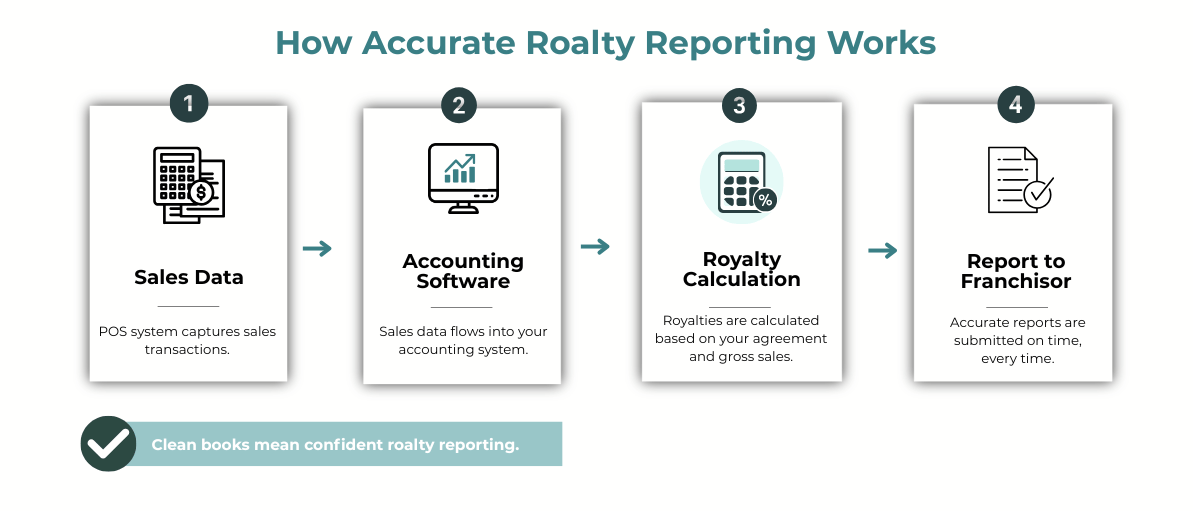
This is the big one, and it is the mistake that keeps a lot of franchise owners up at night.
Most franchise agreements require you to pay royalties as a percentage of your gross sales. Those same numbers get reported back to the company you franchise with, and they directly affect what you owe. So if you are not fully confident in your financials, you are stuck in a tough spot. You either guess and hope, or you second-guess every report you send.
The errors here are usually simple. A misunderstanding of what counts as gross sales. A formula error buried in a spreadsheet. A payment or report that goes out late. None of these feel like a big deal in the moment. But inaccurate reporting can trigger an audit from your franchisor, and if there is an underpayment, you can be on the hook for back royalties, interest, and penalties. That holds true whether the mistake was deliberate or an honest slip.
Flip it around, though, and this is where clean books really pay off. When your financials are accurate and current, you can report with confidence, knowing the numbers are right and that you are paying exactly what you owe. Not a dollar more.
What "gross sales" actually include
Your franchise agreement defines gross sales, and that definition is not always intuitive. Depending on your agreement, things like sales tax, refunds, and certain other categories may be left out of the calculation. The cleanest way to stay accurate is to have your point-of-sale system feed directly into your accounting, so the royalty math happens the same way every time instead of by hand.
Mistake 3: Running a multi-unit franchise like one big business
If you own more than one location, your financials become more complicated. A common misstep is to lump all your locations into one bucket and focus only on the combined total.
The problem is that the combined total hides the story. One location might be quietly carrying another, and you would never know it from a single lumped-together report. What you want is the ability to see each unit on its own and roll them up into a consolidated view, all built on a consistent chart of accounts (often the one your franchisor provides). When every location is tracked the same way, you can actually compare them, spot what is working, and fix what is not.
Mistake 4: Mixing personal and business finances
You use one card and one account for everything, business and personal, and tell yourself you will sort it out later. Later tends to be messy. Blending the two makes your books harder to trust, causes you to miss deductions you were entitled to, and turns any future audit or sale into a headache. The fix is refreshingly simple: separate accounts, clean categories, and consistent bookkeeping from the start. Your future self will thank you.

Mistake 5: Losing track of marketing and ad fund fees
On top of royalties, many franchises require you to contribute to a marketing or advertising fund, usually another set percentage of your revenue. It is easy to let those payments blend into your general expenses and forget they are even there.
Keep them separate. When marketing fees get folded into a catch-all expense category, your books get murky, and your reporting can drift off course. Tracking them on their own line keeps your franchise accounting clean, shows you exactly what you are spending, and lets you actually use that information when you plan ahead.
Mistake 6: Treating tax season as a once-a-year scramble
If taxes only cross your mind in the spring, you are setting yourself up for surprises, and rarely the good kind. Reactive tax handling is how owners end up with unexpected bills, missed deductions, and cash flow crunches at the worst possible time.
Franchise owners have a lot to juggle here. Depending on where and how you operate, you may be dealing with payroll taxes, sales tax, and sometimes corporate or multi-state filings. Add employees to the mix, and payroll alone gets more involved. There are also deductions that quietly go unclaimed: software, build-out costs, training, equipment, insurance, and depreciation on your assets.
The owners who avoid the year-end scramble are the ones who treat taxes as an ongoing conversation rather than a deadline. Regular check-ins throughout the year mean fewer surprises and more money kept in your pocket.
How KeyLin Advisors makes accounting for franchises easier
At KeyLin Advisors, we help franchise owners keep clear, compliant financials, so you can report up to your franchisor with confidence and know your royalty numbers are right every time.
We are also a true one-stop shop. Bookkeeping, payroll, and taxes all live in one place, handled virtually by a team of specialists who actually talk to each other. Our pricing is flat and tailored to what you need, with no jargon and no surprises, and our cloud-based tools give you real-time clarity into your business whenever you want it.
You bought into a franchise because it works like a business-in-a-box. Your accounting should feel the same way: simple, proven, and off your plate. If you are ready to stop second-guessing your numbers, let's talk.